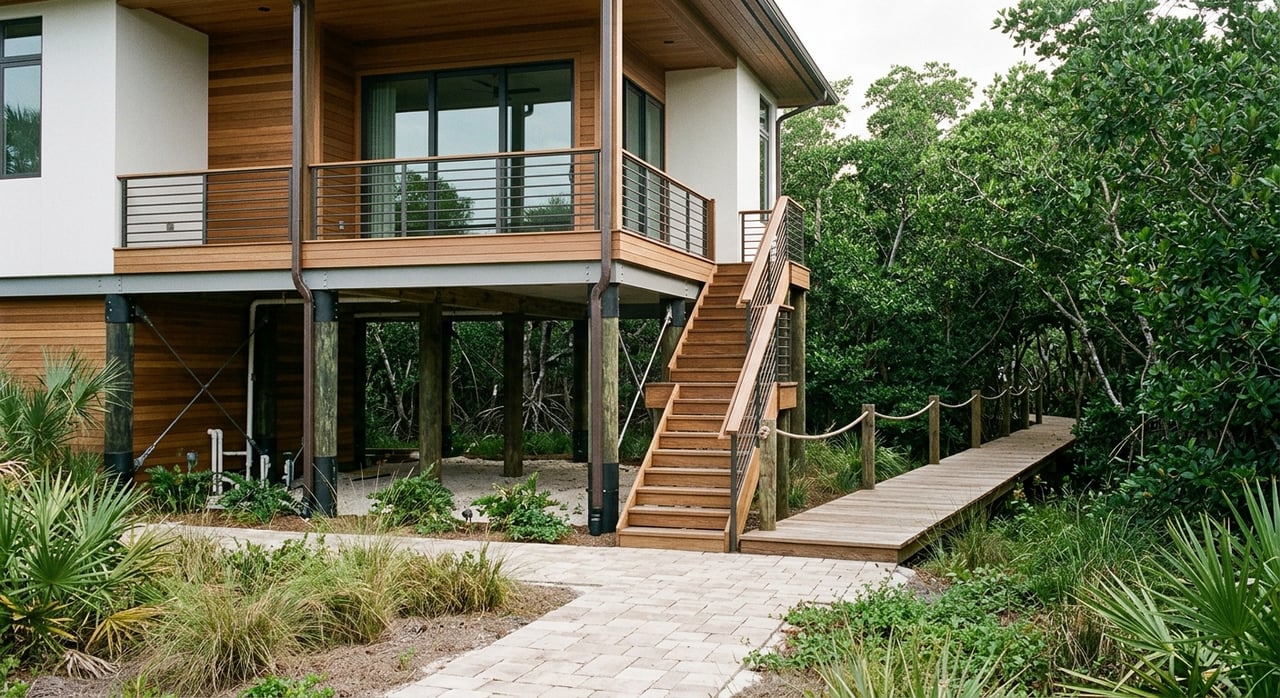
What to Know About Marsh Landing Waterfront Lots
April 23, 2026
April 23, 2026
Thinking about building on a waterfront lot in Marsh Landing? It can be an exciting opportunity, but it also comes with more moving parts than many buyers expect. Between HOA design standards, floodplain rules, stormwater requirements, and dock limitations, the difference between a beautiful plan and a costly surprise often comes down to early due diligence. This guide walks you through the key issues to understand before you buy or build, so you can move forward with more confidence. Let’s dive in.
Marsh Landing is a gated community in Ponte Vedra Beach with more than 1,000 homes, along with golf, tennis, parks, and access to the Intracoastal Waterway, according to the community association. For buyers looking at waterfront property, that setting is a big part of the appeal.
It also means your lot is shaped by more than its recorded dimensions. On marsh-front or water-oriented homesites, view corridors, drainage, setbacks, easements, and environmental limits can all affect what you can actually build. In practical terms, the legal lot size and the true buildable area may not be the same.
Before you focus on house plans, start with the lot itself. Marsh Landing’s current ARB Green Book explains that the buildable area of a lot depends on easements, building setbacks, tieback setbacks, and environmental restrictions.
The same guide notes that homes are typically limited to no more than 35 feet above finished grade. It also states that HOA covenants can supersede county setback requirements. That is why a lot that looks generous on paper may still have a tighter design window once all restrictions are mapped out.
Before closing on a waterfront lot, make sure you understand:
A survey-based review early in the process can help you avoid redesign costs later.
In Marsh Landing, the Architectural Review Board plays a major role in what gets built. According to the ARB information page, all exterior modifications require approval, including like-for-like replacements and tree removals.
That requirement goes well beyond the home itself. The Green Book says no land clearing, lot grading, driveway work, or landscape changes may begin before on-site ARB review and approval. It also requires silt fencing and tree barricades to be installed before clearing starts.
This is an important distinction for buyers and builders. The ARB states that its approval covers aesthetics only and does not replace governmental permits, easements, setbacks, or code compliance.
In other words, you may need approval from both the HOA and local or state agencies. One does not cancel out the other, so your schedule should account for both layers.
The ARB meets on the first and third Tuesday of each month and posts submittal deadlines in advance, according to the association’s ARB page. If your architect, builder, or landscape team misses a deadline, your project timeline can shift quickly.
For that reason, it helps to plan backward from your desired construction start date. Waterfront builds usually move more smoothly when your team prepares the full package early, including surveys, grading details, drainage information, and elevation data.
If your lot falls within a Special Flood Hazard Area, county floodplain rules will matter from the start. St. Johns County Floodplain Management states that new construction, substantial improvements, and repairs after substantial damage in these areas must follow county and Florida Building Code rules, and floodplain development requires a construction permit.
The county’s building permits guidance also notes that applications are generally reviewed after a clearance sheet is issued. Depending on the property, you may also trigger additional permits from water management, state, or federal agencies.
On marsh-front property, stormwater planning is not a side issue. St. Johns County stormwater permitting guidance says a St. Johns River Water Management District stormwater permit is required for almost any work that affects drainage systems or changes a property’s use or structures.
For many projects, the county says you may need signed-and-sealed drainage plans, drainage calculations, an as-built survey, a legal positive outfall, and finished-floor elevations at least 1 foot above FEMA 100-year levels in A flood zones. That is a major reason why custom design, engineering, and site planning need to happen together.
County development guidance also requires wetlands and buffer mapping on site plans, as outlined in the Development Review Manual. Where contiguous wetlands or certain waterways are involved, required upland buffers can meaningfully reduce the area available for improvements.
For you as a buyer, that means due diligence should go beyond a simple lot flyer or plat sketch. A lot can be attractive, private, and well located, but still have a more limited build envelope than expected.
In many communities, buyers assume landscaping can be handled later with minimal review. Marsh Landing is different. The Green Book explains that projects affecting more than 25 percent of the landscape area can require ARB review, while non-native or invasive plants are discouraged or prohibited, and protected trees cannot be removed without approval.
That matters because landscape design is often part of how a waterfront home frames views, privacy, and drainage. If your plan includes major regrading, tree work, or extensive outdoor improvements, those decisions should be coordinated early with the ARB and your design team.
One of the biggest misconceptions with waterfront property is assuming every lot allows the same kind of dock or boat use. In Marsh Landing, the rules are specific.
The Green Book states that covered dock areas are not approved, marine-grade materials are required, turbidity screens are required, and prior ARB approval plus any required FDEP or other agency permits must be submitted before review. It also says docks cannot interfere with navigation.
For the Intracoastal Waterway, the guide states that no docks or boatlifts are permitted, although small floating docks may be approved case by case and may not be used to store motorized watercraft. Lake docks are also limited in size and cannot be used for permanent mooring or storage.
This is a critical due-diligence point. Depending on the exact parcel and sub-association, waterfront access may mean a private dock, a limited-use floating dock, shared access, or no private dock at all.
The state layer matters here too. Florida DEP’s dock permitting guidance shows that some single-family docks may self-certify as exempt, but size and location limits apply. Larger or more complex projects may require more extensive review.
So if boating access is one of your top goals, it is worth confirming the exact rules for that specific lot before you close. Assumptions can be expensive on waterfront property.
A custom home should fit your lifestyle, but it should also respect the lot and the neighborhood. That balance matters for future resale.
Waterfront scarcity often supports demand. For example, NOAA research on Gulf Coast housing markets found that buyers paid higher prices for homes near most waterfront types. At the same time, Realtor.com notes that overly personalized layouts can narrow the buyer pool later.
If you want flexibility and resale appeal, it can help to prioritize:
That approach tends to serve both current enjoyment and future marketability.
Building on a Marsh Landing waterfront lot is rarely just about choosing a builder and a floor plan. The lot, HOA rules, floodplain requirements, stormwater design, and possible dock restrictions all intersect.
That is why local guidance matters so much at the front end. An experienced local architect, builder, and real estate advisor can help you identify buildable-area issues, approval timing, and property-specific limitations before they become costly surprises.
If you are considering a Marsh Landing waterfront lot or planning your next move in Ponte Vedra Beach, Julie Little Brewer offers the kind of neighborhood-level insight that can help you evaluate the opportunity with clarity and confidence.
October 15, 2026
October 8, 2026
October 1, 2026
September 24, 2026
September 17, 2026
September 10, 2026
September 3, 2026
August 27, 2026
August 20, 2026
A seasoned full-time real estate professional, Julie has developed her expertise over decades of experience living and working in the area she calls home. She encourages you to contact her to become your trusted real estate partner. Together, let's achieve real estate success!
JULIE LITTLE BREWER
RE/MAX SPECIALISTS PV
250 A1A N STE 500
Ponte Vedra Beach FL 32082