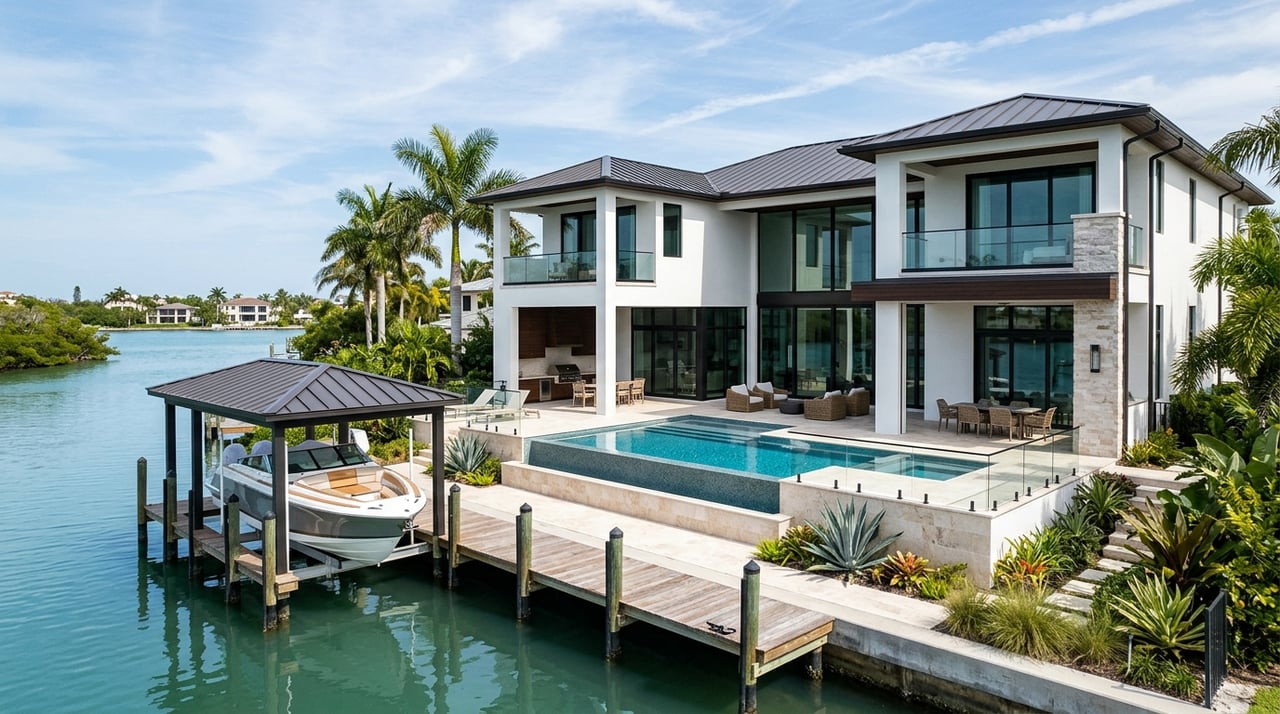
Queens Harbour Boating Community Guide for Buyers
July 16, 2026
July 16, 2026
If you want a home where your boat and your golf clubs both get regular use, Queens Harbour is one of the few Jacksonville communities built around that exact lifestyle. Buying here can feel exciting, but it also comes with details that matter, from lock access and draft limits to optional club membership and approval rules for future property changes. This guide will help you understand how Queens Harbour works in 32225 so you can evaluate homes with more clarity and confidence. Let’s dive in.
Queens Harbour Yacht and Country Club is a gated waterfront community in Jacksonville’s 32225 ZIP code. According to the community, it was founded in 1990 and includes more than 1,000 custom-designed homes, along with the Providence Island enclave of upscale townhomes and single-family residences with landscape maintenance.
Its setting shapes the experience of living there. The community is bounded by water on three sides and connects to the Intracoastal Waterway through a spring-fed lagoon, which makes boating a daily convenience for some owners and a major draw for many buyers.
Location also plays a big role in its appeal. The community says residents are less than 30 minutes from downtown Jacksonville and within about 15 minutes of beaches, parks, employers, shopping, and medical facilities.
Queens Harbour is not a one-size-fits-all neighborhood. You may find lagoon-front homes with private docks, homes that rely on the centrally located marina, and residences on Providence Island that offer a different ownership setup with landscape maintenance.
That variety can be a strength if you know what you want. Some buyers prioritize direct water access, while others care more about golf, club life, or a lower-maintenance property within a gated setting.
Before you narrow your search, it helps to define your lifestyle in practical terms. Think about how often you plan to boat, whether golf membership is important to you, and how much exterior upkeep you want to manage.
For boaters, the lagoon and lock system are central to the buying decision. Queens Harbour’s boating access runs through a 110-foot lock that connects the spring-fed lagoon to the Intracoastal Waterway.
This setup can be a major advantage, but it also means you should evaluate more than whether a home has a dock or whether a slip is available. You need to understand how your vessel fits the community’s operating system.
The community says the lockmaster monitors VHF channel 78A, and vessels must contact the lock operator before entering. Outbound boats should call once underway, and inbound boats should call when they arrive at the channel entrance.
Lock hours also change by season. Reported hours are 8:00 a.m. to 6:00 p.m. in winter, and 8:00 a.m. to 8:00 p.m. Monday through Friday plus 7:00 a.m. to 8:00 p.m. on weekends in summer.
One of the most important buyer questions is whether your boat actually works with the harbor conditions. Queens Harbour notes that it performs periodic dredging but does not guarantee a specific depth.
The community also states that a minus-2 reading at the marked piling corresponds to a maximum draft of about five feet through the lock entrance. If your vessel has deeper draft, you should verify current conditions and your boat’s draft with the harbormaster before you assume the property will support your boating plans.
The community also markets unobstructed overhead access for watercraft with fishing towers and tall masts. Even so, buyers with taller equipment should confirm exact dimensions before closing.
If you are not buying a lagoon-front home with a private dock, the marina may still support your lifestyle well. The marina page says there are 65 slips with fixed concrete docks that can accommodate boats up to 100 feet, with 30- and 50-amp power service and metered utility charges based on usage.
The community also rents personal watercraft ports and storage racks for canoes, kayaks, and paddleboards. It says the lagoon averages 8 feet or more of water depth, which can be helpful context when comparing boating options inside the neighborhood.
There is also an outside floating dock that is 120 feet long and includes water, shore power, and a fish-cleaning station. According to the community, it is useful for boaters heading out before sunrise or returning after normal lock operating hours.
Golf is a major part of the Queens Harbour identity, but buyers should understand how access works. The Country Club at Queen’s Harbour describes its course as designed by Mark McCumber and bordered by the Intracoastal Waterway.
The club says the golf program includes a putting and chipping green, a driving range, and a full-service clubhouse with private dining, verandas, and a 19th hole overlooking the marina. The course has also hosted events including PGA Tour Qualifier, FSGA State Championship Qualifiers, and the Mercedes Collegiate Championships.
Just as important, country club membership is optional for homeowners. That means golf, dining rooms, and member events are not automatically included with homeownership through the HOA.
This distinction can affect both your budget and your expectations. If you plan to play regularly or want access to club dining and events, you will want current membership information during your due diligence.
If golf is more of a nice-to-have than a must-have, that flexibility may appeal to you. You can focus on the neighborhood setting and boating features without assuming you must join every amenity program.
Queens Harbour offers more than a golf course and marina. The official community site lists a broad mix of resident clubs and activities, including the Harbour Sailing Club, Ladies Golf Association, Newcomers Club, Pickleball Club, Veterans Club, Wine Club, and Yacht Club.
That broader amenity mix can shape daily life in a meaningful way. It gives the neighborhood a more layered feel for buyers who want social options and casual recreation beyond one primary hobby.
The POA campus amenity project added a pavilion, four pickleball courts, a junior-size basketball court, a walking path, playground improvements, and additional parking. For many buyers, that makes Queens Harbour feel active without being limited to a single lifestyle lane.
The Yacht Club is open to residents, country club members, and slip lessees. The community also notes that it has never been necessary to own a boat to join.
That can matter if you enjoy the boating environment but do not plan to keep a vessel full time. The Harbour Sailing Club also offers classes at the marina and runs youth and adult programming.
When you buy in Queens Harbour, you are not just buying a home. You are also buying into a structure of ownership rules, amenities, and possible layered costs that should be reviewed carefully.
The community FAQ says purchasing a home automatically makes the owner of record a member of the association, with one vote per property. It also notes that Providence Island is the only sub-association within Queens Harbour.
Lease rules matter too, especially if you are considering part-time use or future rental flexibility. According to the FAQ, the minimum lease term is six months.
A smart budget review should go past the main assessment line. In addition to HOA assessments, buyers may need to factor in optional country club dues, annual Yacht Club fees, marina slip rent, metered electrical service, and any personal watercraft or storage-rack rental.
Some resident clubs may also have separate dues or fees. The public community pages list examples such as Garden Club annual dues of $25, a 2023-2024 Ladies Golf Association fee of $60, and no-fee membership for the Veterans Club.
Current figures should always be confirmed during your resale-document review. That is especially important if you are comparing two properties with very different marina, club, or maintenance needs.
In a community like Queens Harbour, rules can affect how you use and improve your property. The community identifies the QHRRP as its centralized, searchable set of rules, policies, procedures, and related information.
According to the community, the board approved the QHRRP to align with the governing documents, Florida statutes, and city ordinances, and it supersedes prior policies. For buyers, that means current rules matter more than older brochures or outdated resale materials.
This is especially important if you expect to make exterior changes after closing. Assumptions can lead to delays, added cost, or disappointment.
The ARB guidelines state that approval is required before new home construction or modifications to existing property. Meetings are generally held on the second and fourth Wednesdays of each month, with submission deadlines eight days in advance.
The quick-reference guide shows that changes involving docks, lifts, pilings, bulkheads, driveways, paint, patios, pools, pergolas, and similar exterior items can require formal submittals. If you are buying with renovation plans in mind, this process should be part of your timeline from day one.
Queens Harbour is a lifestyle purchase, so your due diligence should be specific to how you plan to live there. A generic home search approach may miss details that matter in this community.
Use this checklist as you compare homes:
The right home in Queens Harbour is not always the one with the biggest boat slip or the most dramatic golf view. It is the one that matches how you will actually use the community week after week.
If you are a serious boater, vessel fit, lock routines, and marina details may drive your decision. If you are centered on golf and social life, optional membership structure and club access may matter more.
For many buyers, the appeal is the combination. Queens Harbour offers a rare mix of waterfront access, established custom homes, and club-centered living in one gated Jacksonville setting.
If you are considering a move in Queens Harbour, working with an advisor who understands waterfront and golf-community details can help you ask better questions before you write an offer. To explore available opportunities in this niche part of Jacksonville, connect with Julie Little Brewer.
October 15, 2026
October 8, 2026
October 1, 2026
September 24, 2026
September 17, 2026
September 10, 2026
September 3, 2026
August 27, 2026
August 20, 2026
A seasoned full-time real estate professional, Julie has developed her expertise over decades of experience living and working in the area she calls home. She encourages you to contact her to become your trusted real estate partner. Together, let's achieve real estate success!
JULIE LITTLE BREWER
RE/MAX SPECIALISTS PV
250 A1A N STE 500
Ponte Vedra Beach FL 32082