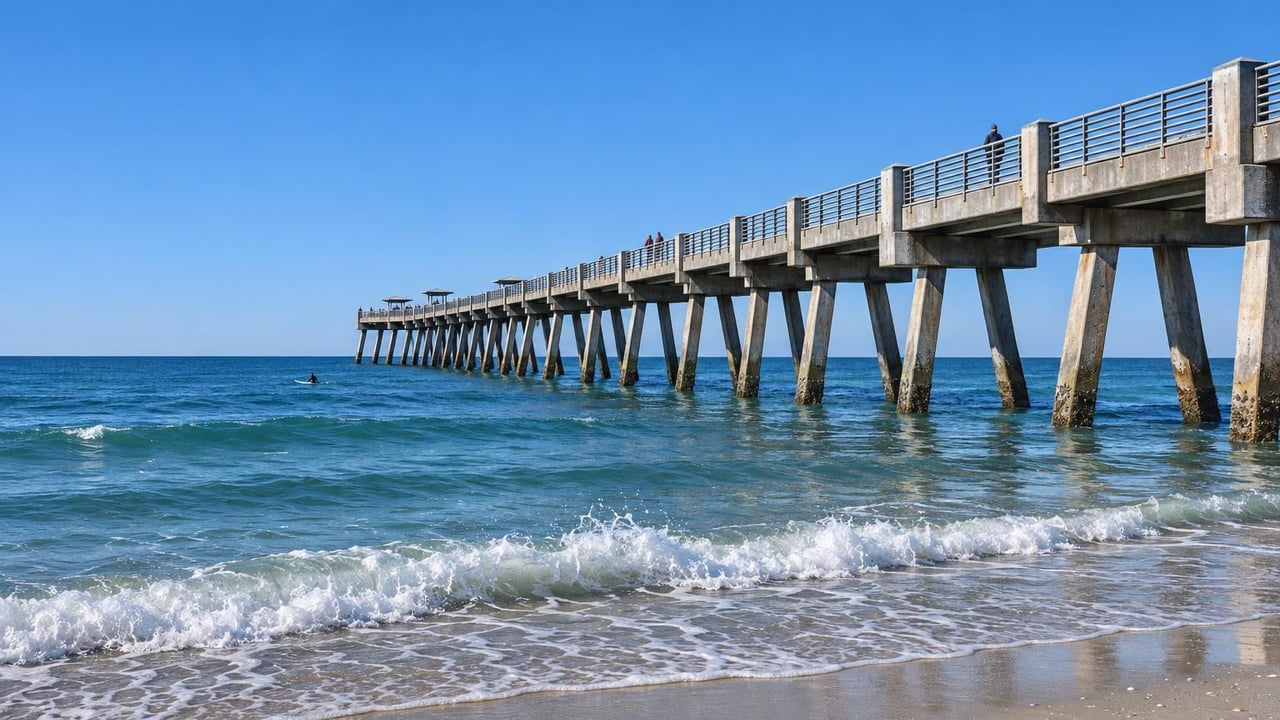
The Jacksonville Beach Pier After the Kingfish Leave
November 26, 2026
November 26, 2026
In the second week of September, Capt. Roger Bump's weekly forecast in Florida Sportsman reported 11 kingfish caught in a single day off the Jax Beach Pier. The water was still in the 80s, and he called the nearshore kingfish bite "a heck of a bite." Six weeks later his Oct. 23–25 forecast opened by calling it "one heck of a nor'easter" and said the ocean was "closed." By his Nov. 6–8 forecast, the storm had run for three long weeks.
That stretch marked the turn of the pier's year. On Thanksgiving, the pier at 503 1st Street North is a different place from the one summer visitors know. Different fish are around the pilings, parking costs less, and a quarter mile out over the Atlantic you are well placed to watch the horizon during right whale calving season. For anyone with a local pass, the next four months may be the best value the pier has all year.
Bump's Nov. 20–22 forecast put the water in the low seventies and slowly dropping. Surf anglers were reporting pompano running off the south end of Amelia Island. His late-October forecast had already called the cold-water lineup for the beaches: a run of pompano and whiting closer to shore, and sheepshead along jetty rocks and inlet pilings. These forecasts cover the coast from Fernandina Beach to Flagler Beach rather than the pier itself.
Sheepshead are the fish that tie the forecast to the structure. Bump wrote in his Nov. 20–22 forecast that they are "feeding heavy," and he named the bait outright: "there is no better bait for them than fidder crabs." His Nov. 6–8 forecast described black drum, sheepshead and redfish feeding around oyster beds and heavily shelled pilings. He recommended light tackle, a size-2 hook and no more than 3/16 ounce of weight. A barnacled pier piling is the same kind of structure. Fished straight down along the pilings rather than cast toward the horizon, the same rig works from the pier.
Bump also explained why the hook-set feels different with these fish. A redfish or black drum takes a fiddler crab the way it takes a live shrimp. A sheepshead "will very lightly add a noticeable pressure," and he suggested slowly bending the rod before setting the hook.
Bait, tackle and rod rentals are handled on site by the pier's operator, Beach Life Rentals.
Walking and fishing fees have been in place since January 1, 2023, and the City of Jacksonville Beach's facility page posts the same schedule as the operator. The local rates are the ones that matter for a Thanksgiving-to-Easter habit, and the bundles change the math more than the annual passes do.
A local day pass to walk the pier is $1.50, and a non-local pass is $2.50, with 50 cents off per person for cash. A 20-entry walking bundle is $15, which works out to 75 cents a walk, half the local day rate. The $90 annual walking pass includes VIP discounts. At the local day rate, it takes 60 walks to cover it.
Fishing runs $4.50 a day for locals and $5.50 for non-locals. The 20-entry fishing bundle costs $60, or $3 a trip. The $300 annual fishing pass would take about 67 local day trips to match. Rod rentals are $15 plus tax for the day.
So a weekly sheepshead morning from now through mid-March comes to roughly 16 trips. The $60 bundle covers that with entries left over. The annual pass pays off for someone who fishes the pier more than once a week all year, kingfish season included.
Parking adds to the winter savings. The operator's parking page says paid parking near the pier is enforced only from spring to fall. In season, Monday through Thursday is free, and fees apply Friday through Sunday and on holidays and festival days. Free street parking is available outside the major lots, with time limits in some spots. The city's paid parking fact sheet carries the exact enforcement dates, so check it before a holiday-weekend visit.
The operator lists hours of 6 a.m. to 10:30 p.m. daily. That leaves time for a sunrise session before work, which is when Bump's Nov. 6–8 forecast had high tides starting the mornings. The posted rules allow three rods per person and ask anglers to follow FWC and local regulations. The city's list adds no pets except service animals, no food or alcohol on the pier, no sitting on the rails, and no bicycles, skateboards or surfboards.
Hurricane damage closed the pier again in November 2019, according to the Times-Union. That fall the City of Jacksonville awarded Hal Jones Contractor a $9.88 million contract to repair and rebuild it, as the Jax Daily Record reported. The work rebuilt about two-thirds of the pier. Most of the pier was raised eight feet and lengthened by 10 feet, and the new sections stand on four 24-inch-square piles where three 18-inch piles stood before. It reopened to walkers in July 2022, as The Florida Times-Union reported. In May 2022, the Times-Union put the projected total cost at $11.6 million.
NOAA Fisheries says the North Atlantic right whale calving season runs from mid-November to mid-April. The southeastern coast, from the Carolinas to Florida, is the only known place where the species regularly gives birth. The first calf of the 2026–27 season has already been reported. On November 10, members of the public called in a mother and calf about 11 nautical miles east of St. Augustine Inlet. Scientists identified the mother as Curlew, catalog No. 4190. She is 16 years old and this is her first calf. The Florida Times-Union covered the sighting on November 15.
Last season shows how close these whales can come to the Beaches. NOAA's final count for the 2025–26 calving season was 23 calves, published April 30, 2026. On January 6, 2026, an FWC aerial survey recorded a mother and calf about 13.5 nautical miles off Jacksonville Beach. Other pairs came much closer a few miles south. The Marineland Right Whale Project recorded Callosity Back and her calf off Mickler's Landing on January 11. She is the only North Atlantic right whale known to have callosities on her back rather than just her head. On February 12, a member of the public spotted a whale traveling south off Ponte Vedra from their home. Responders confirmed it was Magic, catalog No. 1243, with her calf. The project notes Magic is 44 years old and this is her eighth known calf.
The project's survey area runs about 70 nautical miles, from Ponte Vedra Beach south to Ponce Inlet. Jacksonville Beach sits just north of it, so a sharp-eyed person on the pier can be the first report a sighting network receives. Volunteers plan to start their 2027 surveys on January 4.
NOAA's identification cues are simple enough to remember at the rail: a V-shaped blow, a broad back with no dorsal fin, and white-looking patches on the head. NOAA takes reports from North Carolina to Florida at 877-WHALE-HELP, or 877-942-5343. The Marineland project and the volunteer sighting network use 888-97-WHALE, or 888-979-4253. A report should include the time and location.
For more on everyday life around the pier, including the Seawalk Pavilion events calendar a few blocks south, see our Jacksonville Beach neighborhood guide and our look at why the Seawalk Pavilion parking lot still hasn't changed. For more on the Mickler's Landing stretch where Callosity Back surfaced last January, read why Mickler's Landing never closes on a weekend.
A home within walking distance of the pier puts those winter mornings on the rail a few blocks away. If you own near the pier in Jacksonville Beach and want to know what that location is worth this winter, Julie Little Brewer would be glad to walk through it with you. Request your complimentary home valuation.
November 26, 2026
November 19, 2026
November 12, 2026
November 5, 2026
October 29, 2026
October 22, 2026
October 15, 2026
October 8, 2026
October 1, 2026
A seasoned full-time real estate professional, Julie has developed her expertise over decades of experience living and working in the area she calls home. She encourages you to contact her to become your trusted real estate partner. Together, let's achieve real estate success!
JULIE LITTLE BREWER
RE/MAX SPECIALISTS PV
250 A1A N STE 500
Ponte Vedra Beach FL 32082